
Your phone rang four times today. You missed three of them.
You were on a roof. Or under a sink. Or halfway through a furnace install. By the time you called back, two of those homeowners had already booked someone else.
Sound familiar? This is how most contractors lose jobs online because nobody found them. Because nobody picked up.
That’s where digital marketing for contractors comes in. And no, it isn’t only about a nice website and a Facebook page. It’s about getting found, getting the call, and turning that call into a booked job.
So, let us now look into “9 Digital Marketing Strategies Contractors Can Use to Win More Customers”!
What Is Digital Marketing for Contractors?
Digital marketing for contractors means using online tools to get more homeowners to call you. Your website. Your Google Business Profile. Reviews. Ads. Texts and emails. And now AI tools like ChatGPT too.
The goal is simple. More booked jobs, at a cost that still leaves you a profit.
Homeowners are already looking for you online. In BrightLocal’s 2026 consumer search study, 52% of consumers started their last local search on Google.
But they don’t trust one source. A small homeowner survey found people Google first, then ask friends, then check reviews, then get more than one quote. One homeowner said they always assume a contractor is selling them more than they need (Domabear homeowner survey).
So your marketing has to build trust at every step. Showing up once isn’t enough.
Why Does Contractor Marketing Stop Working?
Most of the time, it’s not a lead problem. It’s a leak problem.
When we look at a contractor’s marketing, the ads are rarely the biggest issue. The leaks are.
- Calls going to voicemail
- Web forms nobody checks until Monday
- Estimates sent once and never followed up
- Reviews that stopped coming two years ago
Fix those first. Then every dollar you spend on online marketing for contractors works harder.
That’s why almost half of the strategies below happen after the lead comes in. We wrote about this same problem for appliance repair companies too.
1. Build a Website That Books Jobs
Your website has one job. Get the phone to ring. A lot of contractor websites look nice and still don’t bring calls.
Here are a few things your site needs to book jobs:
- A click-to-call phone number at the top of every page on mobile
- One page for each service (AC repair and AC installation are different searches)
- Price ranges or starting prices, if you can share them
- Financing details for big jobs
- Real photos of your team, your trucks, and your work
- A short form with name, phone, zip code, and the problem
Why price ranges? Because homeowners want them. BrightLocal found clear pricing is one of the top three things people look at before contacting a local business, along with complete info and reviews.
Financing matters more than most contractors think. A new AC system or a foundation repair is a big bill. If the homeowner can’t see a way to pay for it, they won’t call. Put it on the page.
And keep the site fast. A slow page on mobile data loses people before they ever see your number.
2. Own Your Google Business Profile
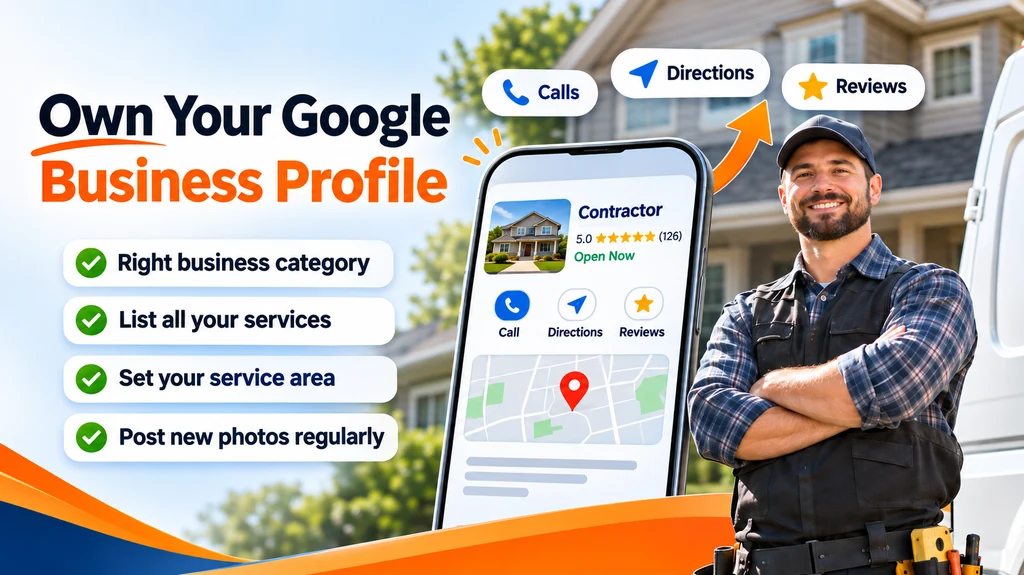
For most contractors, Google Maps brings more calls than the website. Your Google Business Profile decides if you show up there.
The basics:
- Choose the right main category
- Add every service you offer
- Set your real service area
- Post new photos every week
- Keep your name, address, and phone the same everywhere online
We already wrote a full guide on this, so we won’t repeat it here. Read our post on local SEO for HVAC companies. The steps work for every trade. Our local citations guide covers that last point in detail.
3. Get Fresh Reviews Every Week
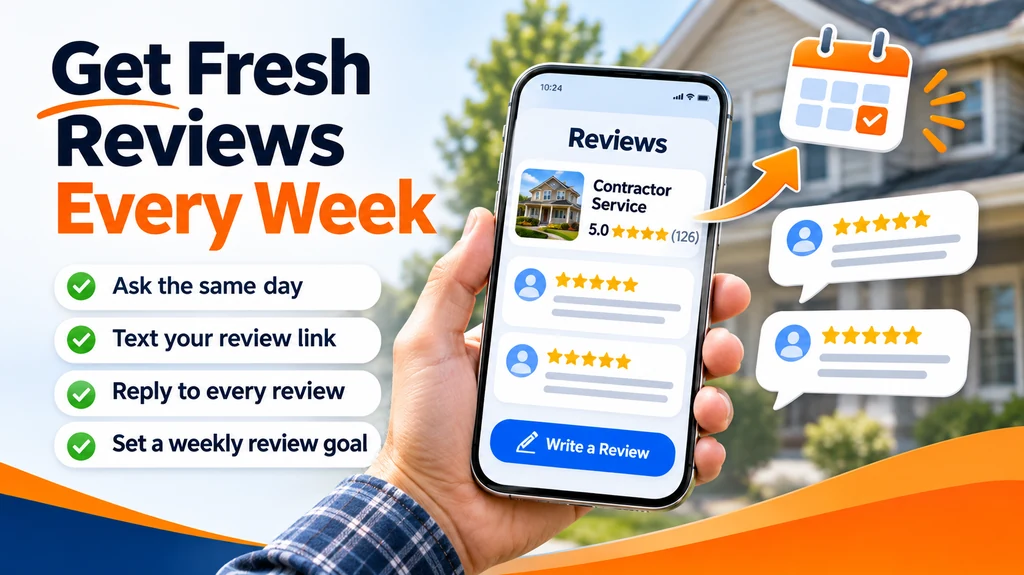
Reviews decide who gets the call.
BrightLocal’s 2026 review survey found 97% of consumers read reviews for local businesses. Almost half won’t use a business with fewer than 20 reviews. And 74% care most about reviews from the last three months (BrightLocal).
So 150 reviews from 2022 won’t help much. New ones will.
Here’s how to keep them coming:
- Ask on the same day the job is done
- Text your direct Google review link within the hour
- Reply to every review, good or bad
- Set a weekly review goal for each tech or crew
For a bad review, stay calm. Say sorry, keep it short, and offer to fix it offline. Future customers read your reply more closely than the complaint.
One thing to avoid. Don’t buy reviews, and don’t only ask happy customers. Google removes those reviews, and fake reviews can now bring FTC penalties.
4. Answer Every Lead in Minutes
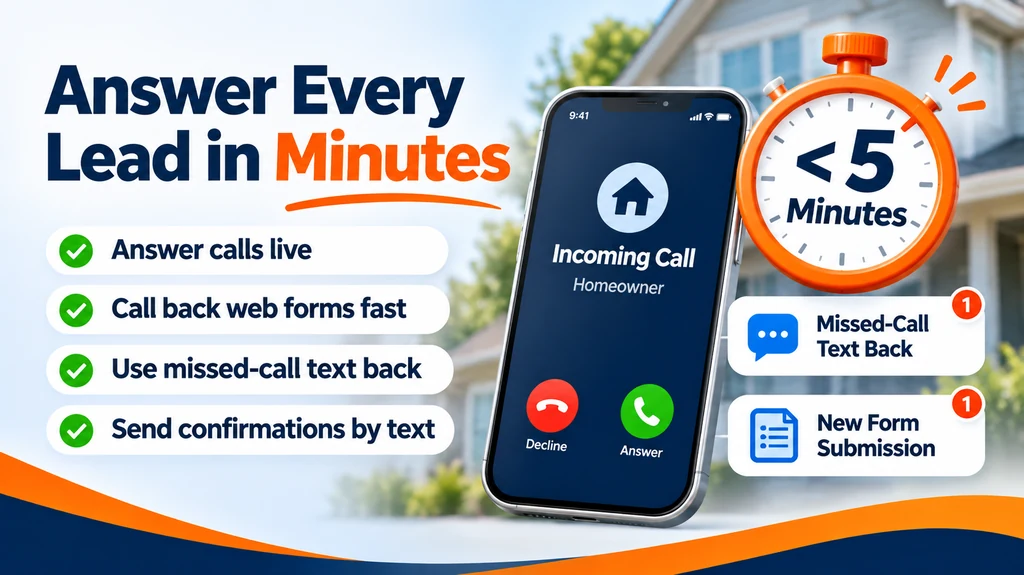
Most marketing guides skip this one. It’s also the one that wins the most jobs.
Think about a homeowner whose water heater burst this morning. They don’t call one plumber. They call three. Or fill out three forms. Whoever calls back first usually gets the job.
Homeowners say this themselves. One ACHR News writer shared how their family picked an HVAC contractor. It wasn’t about price. They chose the company that called back within 24 hours and kept returning calls that fast (ACHR News).
Another homeowner on a building forum said they made 7 calls for a bathroom job. Only 3 called back (Fine Homebuilding forum). The other 4 lost that job without ever knowing it existed.
Research backs it up. A Harvard Business Review study found companies that reached out within an hour were nearly 7 times as likely to qualify a lead as companies that waited longer (Harvard Business Review). That study looked at all kinds of businesses. In home services, where the problem is urgent, the window is even smaller.
We see it in our own client work too. The ads get blamed for “bad leads.” Then we listen to the call recordings. Missed calls. Full voicemail boxes. Forms sitting for hours.
Here are a few fixes that cost little:
- Answer every call live during business hours
- Call back every web form within 5 minutes
- Turn on missed-call text back, so anyone you miss gets a text right away
- Send form confirmations by text, not only by email
- Use an answering service or an on-call tech after hours
- Listen to 5 recorded calls every week
That last one sounds small. It isn’t. You’ll hear exactly why jobs slip away.
5. Run Paid Ads in the Right Order
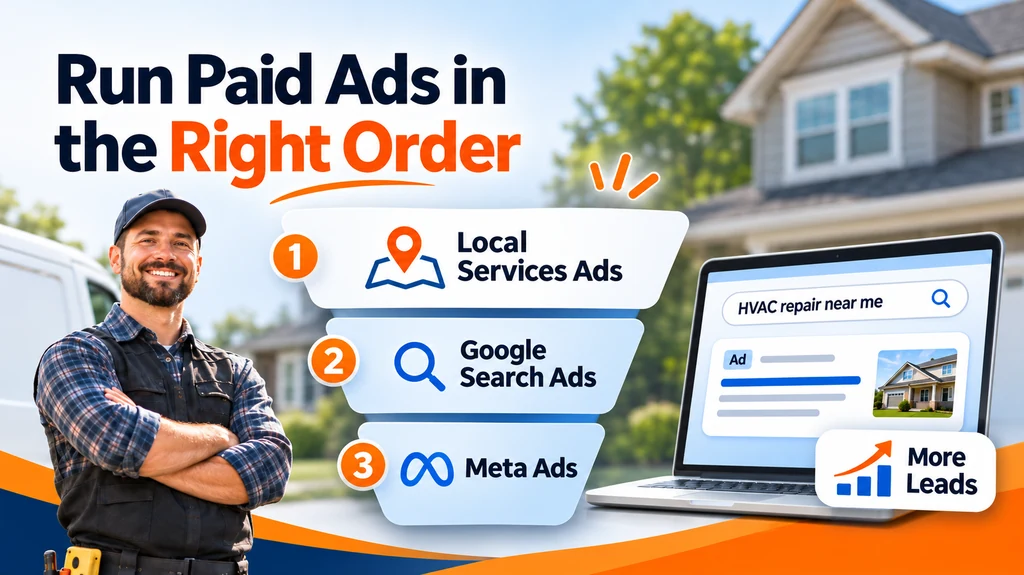
Contractor advertising works best in layers. Don’t turn on every platform on day one.
Start With Google Local Services Ads
These show at the top of Google for searches like “plumber near me.” You pay for leads, not clicks. And you get a Google trust badge next to your name.
People who run them often say the same thing. On Reddit, one user said Local Services should be the foundation, and you should max out that budget before moving to other lead sources.
Then Add Google Search Ads
Target searches with a service and a city in them, like “emergency AC repair Marietta.” Send each ad to its matching service page, never the homepage. Add negative keywords early, like “jobs” and “DIY.”
Then Use Meta Ads for Big Jobs
Facebook and Instagram don’t do much for emergencies. Nobody scrolls Instagram while their basement floods. But they work for bigger, planned jobs like AC replacements, remodels, and waterproofing. Use them to retarget people who already visited your site.
One rule for all three. Only run ads when someone can answer the phone. Paying for a call that lands in voicemail is the most expensive mistake in contractor advertising.
What about lead sites like Angi or HomeAdvisor? Some contractors do fine there. Many don’t. One contractor on Reddit warned others they could end up paying hundreds of dollars a week for useless information. Those leads often go to several companies at once, so speed matters even more.
Want to go deeper on paid search? Read how a PPC management company drives qualified leads and our guide to competitor campaigns.
6. Follow Up on Every Estimate
Most contractors send an estimate and wait. Then they wonder why they didn’t get the job.
Homeowners rarely say no. They go quiet. They’re comparing quotes, talking to their spouse, or waiting for payday. The contractor who follows up, politely and on time, usually wins.
Homeowners notice when you don’t. One contractor on a building forum admitted that even he gets annoyed, as a homeowner, when someone promises a bid soon and never sends it (Fine Homebuilding forum).
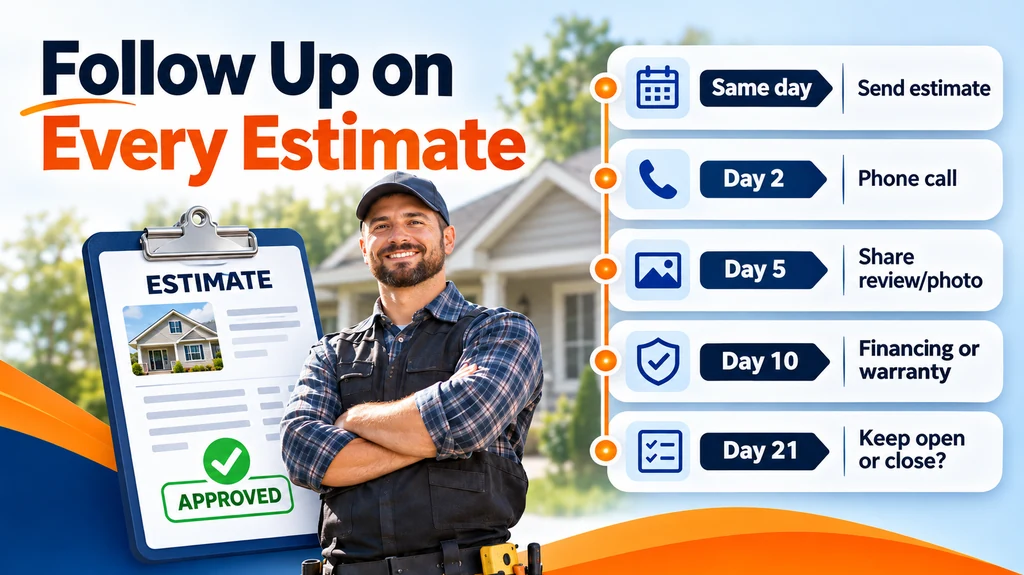
Here’s a simple follow-up plan:
| When | How | What to send |
| Same day | Text and email | The estimate, a thank-you, and a direct number for questions |
| Day 2 | Phone call | Ask if they have any questions about the estimate |
| Day 5 | Text | A recent review or before-and-after photo from a job nearby |
| Day 10 | Financing options or warranty details | |
| Day 21 | Text | “Should we keep this open or close it out for now?” |
That last text works better than you’d expect. People reply to it when they’ve ignored everything else.
Set this up once in your CRM, so it runs on its own. Then track how many estimates turn into jobs. If that number is low, more leads won’t fix it. Better follow-up will.
7. Show Up in AI Search
Homeowners are now asking ChatGPT and Google’s AI Mode who to call.
This happened fast. BrightLocal found that the share of people using AI tools for local business recommendations jumped from 6% in 2025 to 45% in 2026.
Most contractors haven’t caught up yet. That’s your chance.
Here are a few ways to show up in AI answers:
- Answer common questions at the top of your service pages
- Use headings that sound like real questions people ask
- Keep your business name, services, area, and hours the same everywhere
- Add schema markup so search engines can read your details
- Get mentioned on local news sites, trade groups, and supplier pages
AI tools trust businesses that are easy to understand and that other sites talk about.
8. Keep the Customers You Already Have
Contractor customer acquisition costs a lot. Keeping a customer costs much less. Still, most contractors spend almost all their marketing money on strangers.
This one stings. One homeowner wrote about paying a company’s invoice, leaving them a great review, and then calling again six months later for more work. They never heard back. So they hired the crew working next door instead.
That was a happy customer. Gone.
Here are a few ways to keep yours:
- Offer maintenance plans, like AC tune-ups or yearly plumbing checks
- Send reminder texts, like “It’s been a year since your furnace service”
- Give a gift card or service credit for every referral that books
- Mention the referral reward on the invoice and in your thank-you text
- Claim your Nextdoor business page, since neighbours ask for recommendations there every day
Maintenance plans do double duty. You get steady work in slow months, and you’re the first call when something breaks.
9. Track Cost per Booked Job
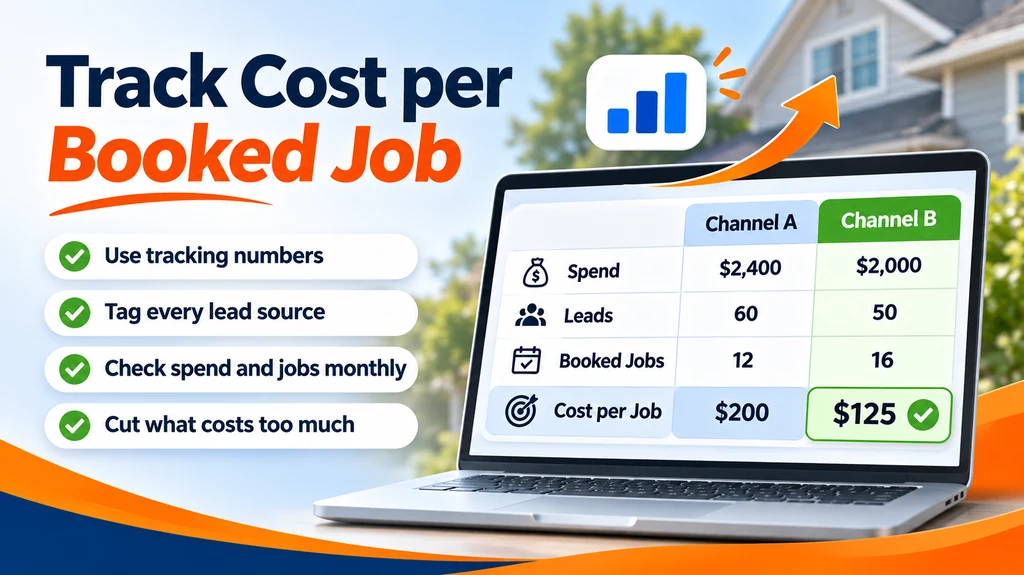
Cost per lead tells you what a phone call costs. It doesn’t tell you what a job costs. Look at this example!
| Channel A | Channel B | |
| Monthly spend | $1,500 | $1,500 |
| Leads | 30 | 12 |
| Cost per lead | $50 | $125 |
| Booked jobs | 4 | 7 |
| Cost per booked job | $375 | $214 |
Channel A looks cheaper per lead. Channel B books more jobs for less money. That’s the number that matters.
Here’s how to track it:
- Use a different tracking number for each channel
- Tag the lead source in your CRM for every job
- Check spend, leads, booked jobs, and revenue every month
- Cut anything that costs more per job than the job is worth
If your agency can’t tell you this number, ask why.
How Should Contractors Split Their Marketing Budget?
There’s no single right number. It depends on how new your business is and how busy you already are.
Here’s the split we usually start with:
| Stage | Where most of the money goes | Why |
| New business | Local Services Ads, Google Business Profile, reviews, a website that converts | Fastest way to get calls while you build trust |
| Growing | Google Search Ads, service and city pages, follow-up systems | Get more demand and close more of it |
| Established | SEO content, AI search, maintenance plans, referrals, retargeting | Lower your cost per job over time |
Whatever your stage, save some budget for call tracking. Spending without tracking is guessing.
How Should You Plan Around Busy and Slow Seasons?
Most trades get busy with the weather. Your marketing should follow it.
| Trade | Busy season | What to do in the slow months |
| HVAC | Summer heat and winter cold | Push tune-ups and maintenance plans in spring and fall |
| Plumbing | Winter freezes, plus repairs all year | Promote water heater replacements and inspections |
| Foundation and waterproofing | Rainy months and after storms | Run inspection offers before the rain starts |
| Appliance repair | Holidays and summer | Promote checkups before the holiday rush |
| Roofing | Spring and after storms | Build reviews in winter, run ads hard after storms |
Two simple rules. Work on SEO and content before your busy season, because rankings take months. Then turn up ads at peak, and use the slow months for reviews and repeat customers.
What Mistakes Should Contractors Avoid?
We see these all the time:
- Sending ad clicks to the homepage
- Letting calls go to voicemail while ads are running
- Judging ads by cost per lead
- Asking for reviews “later”
- Expecting Instagram to bring emergency calls
- Copying one city page 20 times with a new city name (here’s how to build location pages the right way)
- Hiring an agency that can’t tell you your cost per job
How Iynix Digital Solutions Helps Contractors Win More Customers
We work with home service contractors in HVAC, plumbing, appliance repair, and foundation repair.
We build websites that bring calls. We manage Google Business Profiles, Local Services Ads, and Google Ads. We set up review systems, follow-up texts, and call tracking. And we help your business show up in AI search.
Most of all, we don’t stop at clicks. We show you what each job cost and where it came from.
Want to know where your leads are slipping away? Visit Iynix Digital to book your free contractor marketing audit.
Final Thoughts
Digital marketing for contractors isn’t about being everywhere. It’s about doing a few things well.
Get found on Google. Keep fresh reviews coming. Answer fast. Follow up on every estimate. And know what each job costs you.
Do that, and you’ll win jobs your competitors never even knew they lost.
Frequently Asked Questions
What is digital marketing for contractors?
Digital marketing for contractors means using your website, Google Business Profile, reviews, ads, texts, and emails to get more homeowners to call you. It covers getting found online and turning those calls into booked jobs.
What is the best marketing strategy for contractors?
The best marketing strategy for contractors mixes a strong Google Business Profile, fresh reviews, Local Services Ads, and fast replies to every lead. No single channel wins alone. They work together.
How can contractors get more leads online?
Contractors get more leads online by ranking on Google Maps, running Local Services Ads, building one page per service, and getting new reviews every week. Contractor lead generation also improves when you answer calls live and text back missed calls.
How much should a contractor spend on digital marketing?
It depends on your stage. New businesses usually put most of their budget into Local Services Ads, their Google Business Profile, and reviews. Established businesses move more money into SEO, AI search, and repeat customers. Track cost per booked job so you know it’s working.
Is Google advertising worth it for contractors?
Google advertising is worth it for contractors when ads target service and city searches, land on matching service pages, and run only when someone can answer the phone. Local Services Ads are usually the best place to start.
How long does digital marketing take to work for contractors?
Paid ads and Local Services Ads bring calls within days. Google Business Profile changes usually show results in a few weeks. SEO and content often take three to six months or more.
Related Posts
How to Choose an HVAC Marketing Agency
The right HVAC marketing agency fills your schedule year-round. The…

7 Signs It’s Time to Hire an HVAC Marketing Agency
If your phone only rings from repeat customers and referrals,…

Performance Marketing vs Brand Marketing — Which One Actually Grows Your Business in 2026?
Marketing budgets are tight. Every dollar needs to deliver results.…